PPWR Article 6: what "recyclable packaging" means, and from when
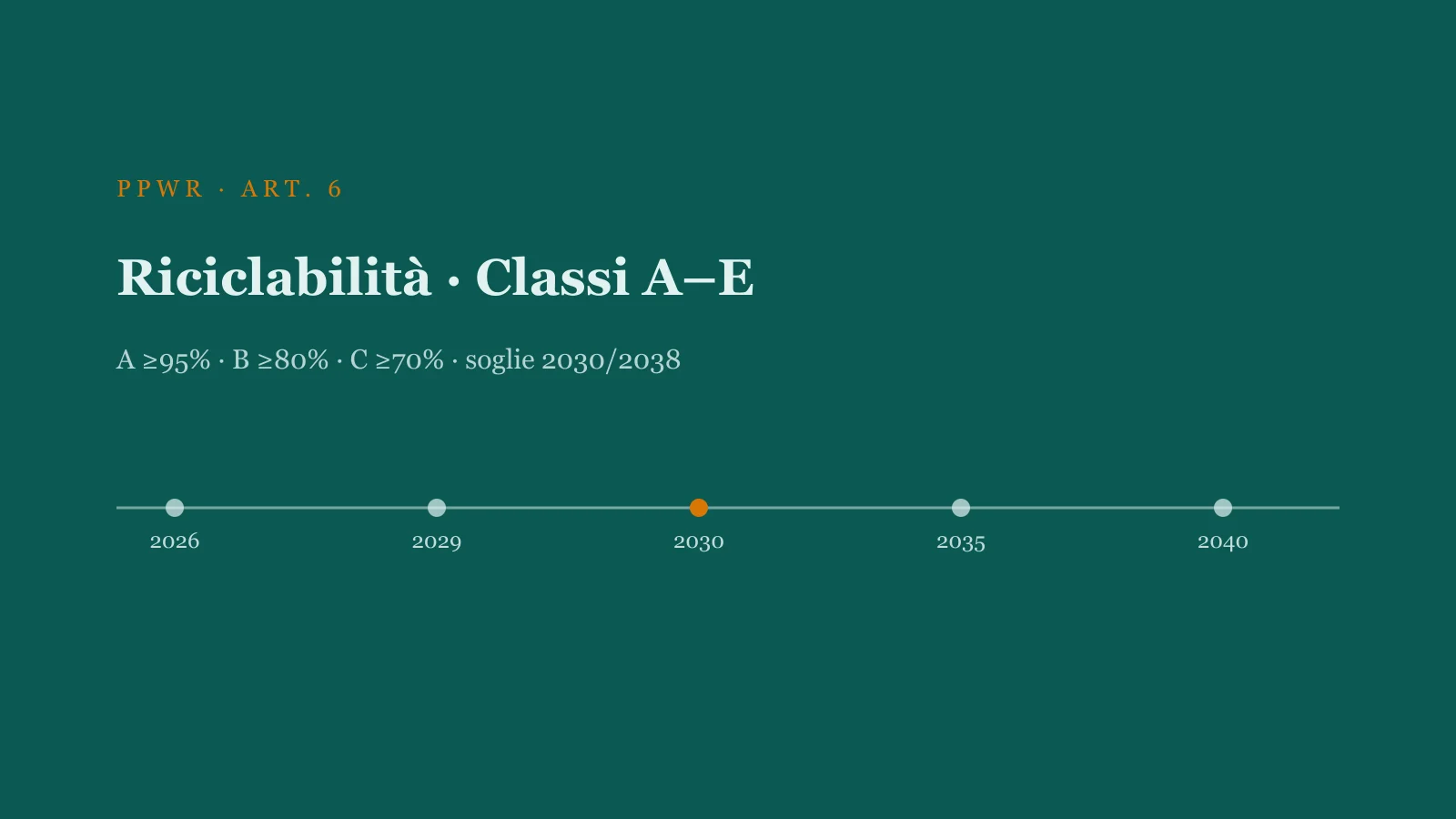
From 1 January 2030, all packaging placed on the EU market must be recyclable. Article 6 of Regulation (EU) 2025/40 sets five performance classes (A–E): from 2030 only A, B and C are allowed; from 2038 only A and B. If your packaging fails here, no other article matters.
What the regulation says
Article 6 assesses recyclability on two levels: design-for-recycling (compatibility with collection and recycling systems) and recyclability at scale (the real industrial capacity to handle the format). The class is assigned by percentage recyclable by weight: A ≥ 95%, B ≥ 80%, C ≥ 70%; below 70% (D and E) the packaging counts as non-recyclable. Deadlines: from 1 Jan 2030 only A/B/C on design criteria; from 2035 the "recycled at scale" test applies; from 2038 the minimum threshold rises to ≥ 80% (C also excluded). (Reg. EU 2025/40, Art. 6 and Annex VII — EUR-Lex).
What it means for your SKU
This is the PPWR's first filter, not one of many: a class-D pack cannot be sold, full stop. The most exposed formats today are complex multilayer structures (PET+EVOH, aluminium+plastic), laminated films and composites that can't be separated by hand — exactly the packs that deliver barrier and shelf-life in food and beauty.
The point teams underestimate: the recyclability class isn't just market access, it's price. EPR fees across the EU — and CONAI bands in Italy — already modulate on expected recyclability, so the gap between a multi-material (top band, up to €790/t) and a well-designed mono-material (lowest band, €40/t) can be worth hundreds of euros per tonne. Article 6 and the fee portfolio are the same decision seen from two sides. And time is short: a redesign cycle runs 18–36 months, so a pack launched in 2026 will still be on shelf in 2030.
What to do now
- Map your SKUs and isolate multilayers and non-separable composites — the first to fall below threshold.
- Estimate the expected recyclability class (A–E) for each and cross it with fee exposure.
- Prioritise redesign for packs that are both Art. 6-at-risk and high-fee: that's where the business case is double.
- Track the delegated acts on methodology (expected 2026–2027): they define the exact calculation criteria.
FAQ
When must packaging be recyclable? From 1 January 2030 on design criteria; from 2035 the recyclability-at-scale test is added; from 2038 the minimum threshold rises to ≥ 80%.
What are classes A, B, C, D, E? Five recyclability performance levels by weight: A ≥ 95%, B ≥ 80%, C ≥ 70%, D and E below 70% (non-recyclable).
Which packaging is most at risk? Complex multilayers, laminated films and composites that can't be hand-separated.
Does Article 6 affect the CONAI fee? Yes: CONAI bands already differentiate the fee by expected recyclability.
Related: Article 7 — Recycled content · PPWR deadlines · CONAI plastic fee bands 2026 · PPWR Guide