PPWR: what EU Regulation 2025/40 on packaging is, and from when it applies
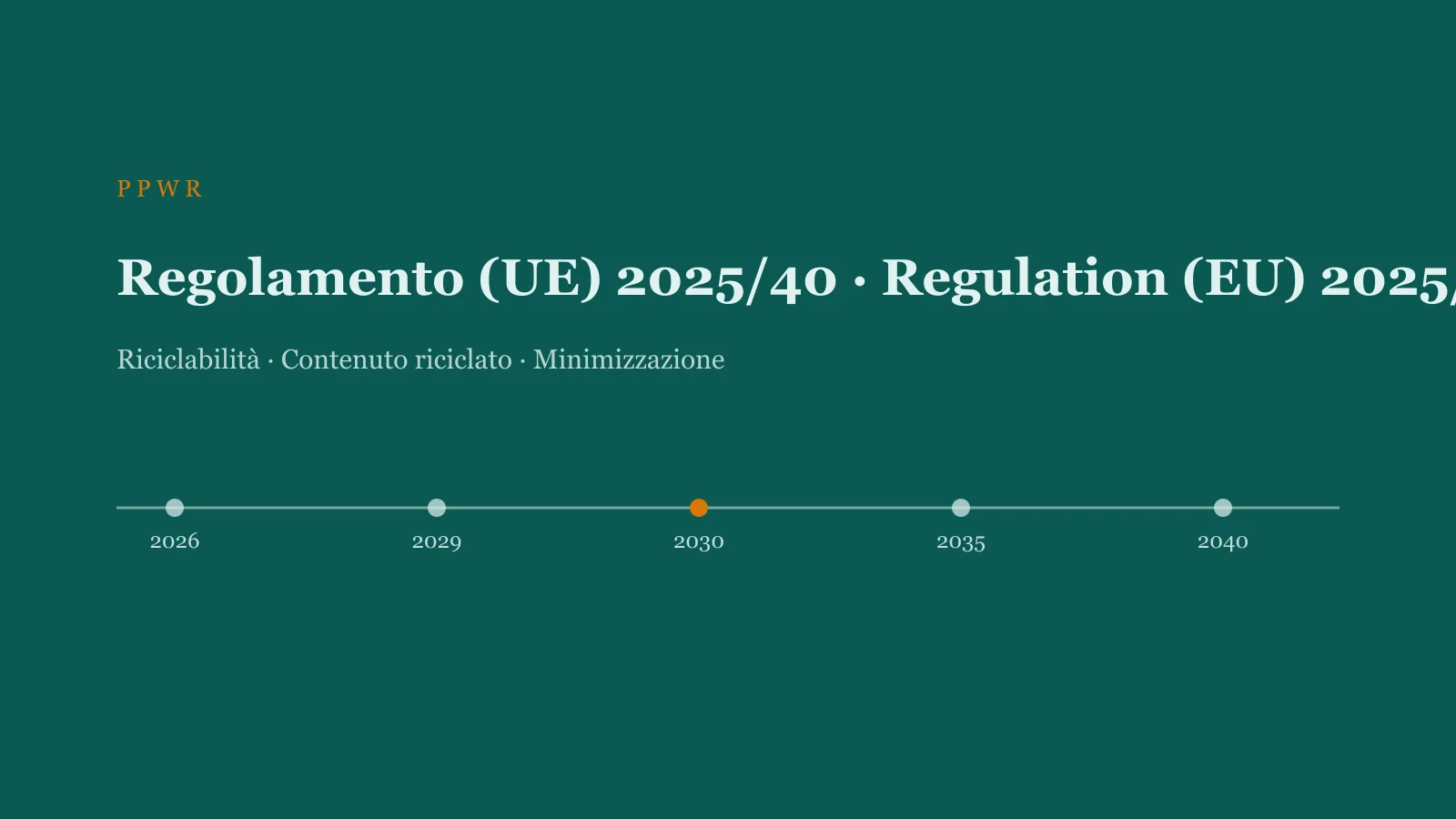
The PPWR (Packaging and Packaging Waste Regulation) is Regulation (EU) 2025/40: it applies across the EU from 12 August 2026 and covers anyone who places packaging or packaged products on the market — manufacturers, importers, distributors, brand owners. It replaces Directive 94/62/EC and, being a regulation, applies directly without national transposition. Three requirements decide whether your packaging is compliant: it must be recyclable (Art. 6), contain a minimum share of recycled plastic (Art. 7) and be minimised in volume and weight (Art. 24 and 10).
What the regulation says
Regulation (EU) 2025/40 was published in the Official Journal of the EU on 11 February 2025, entered into force the same day and applies generally from 12 August 2026, eighteen months later. It is structured in 188 recitals, 13 Chapters, 71 articles and 13 Annexes, and covers the full packaging lifecycle: design, placing on the market, labelling, end of life.
The difference from the Directive 94/62/EC it repeals is not merely formal. The Directive set targets each Member State transposed with its own rules; the PPWR is a maximum-harmonisation regulation, identical across Member States and directly binding. The approach to recyclability also changes: no longer national percentage targets by material, but design-for-recycling obligations on the individual SKU. Add mandatory reuse and refill targets by category, overpackaging restrictions and convergence with the Digital Product Passport. (Reg. EU 2025/40 — EUR-Lex).
What it means for your SKU
The PPWR is not a single documentary obligation: it is a series of filters your packaging must clear one by one. Three of them decide whether the SKU can stay on the market, and they are worth reading in the order they matter.
1. Recyclability (Article 6). The first filter: from 1 January 2030 all packaging on the EU market must be recyclable. Art. 6 sets five performance classes by recyclable weight — A ≥ 95%, B ≥ 80%, C ≥ 70%, below 70% (D and E) the packaging is non-recyclable. From 2030 only A, B and C are allowed; from 2035 the "recycled at scale" test is added; from 2038 the minimum threshold rises to ≥ 80% and C is excluded too. The most exposed formats are complex multilayers, laminated films and composites that can't be separated by hand. If a pack is class D, no other article matters: it can't be sold.
2. Recycled content (Article 7). From 1 January 2030 plastic parts must contain a minimum share of post-consumer recycled content, with a second step in 2040. Targets differ by category: single-use PET beverage bottles 30% in 2030 and 65% in 2040; other contact-sensitive PET packaging 30% → 50%; contact-sensitive packaging in plastics other than PET 10% → 25%; other plastic packaging 35% → 65%. The typical mistake is reasoning by company average: targets apply per packaging category, not to the aggregate portfolio. And certified recycled material has to be booked now — EU food-grade rPET capacity is limited against expected 2030 demand.
3. Minimisation (Articles 24 and 10). From 1 January 2030 empty space in grouped, transport and e-commerce packaging cannot exceed 50% (Art. 24), and packaging must be designed to minimise weight and volume relative to what it has to contain (Art. 10). The most exposed sectors are e-commerce, beauty and luxury — false bottoms, double walls, oversized boxes.
Here is the point teams underestimate, and it's Evalda's point of view: compliance and cost are the same decision seen from two sides. EPR fees across the EU — and CONAI bands in Italy — already reward the very parameters the PPWR will make mandatory: recyclability, recycled content, sortability. The gap between a multi-material pack and a well-designed mono-material one can be worth hundreds of euros per tonne of fee. Whoever plans the redesign for 2030 targets today gets a fee reduction in the short term, on top of compliance. And time isn't neutral: a packaging redesign cycle runs 18–36 months, so the pack you launch in 2026 will still be on shelf in 2030.
What to do now
- Map your SKU portfolio and isolate the critical packs: multilayers and non-separable composites (Art. 6 risk), plastic packaging without certified recycled content (Art. 7), oversized formats (Art. 24).
- Register in the national producer register by 12 August 2026 (Art. 44) and align the declaration of conformity on SKUs already on the market.
- Cross regulatory risk with fee exposure: prioritise redesign for packs that are both PPWR-at-risk and high-fee. That's where the business case is double — compliance and saving.
- Plan on real redesign timelines (18–36 months): decisions for 2030 deadlines must be taken in 2026–2027.
- Track the delegated acts (expected 2026–2027) on recyclability methodology, recycled-content thresholds and harmonised labelling.
Deadlines at a glance
The PPWR applies from 12 August 2026; by the same date producer-register enrolment kicks in (Art. 44). 2029 brings the 90% DRS collection target for single-use PET bottles and cans. 2030 is the threshold year: mandatory recyclability (Art. 6), first recycled-content targets (Art. 7), 5% per-capita packaging-waste reduction, first reuse/refill targets and the 50% empty-space cap (Art. 24). Then the long steps: 2035 (-10% waste), 2038 (recycled content rises), 2040 (-15% waste). The year-by-year picture is on the PPWR deadlines page.
FAQ
When does the PPWR enter into force? It entered into force on 11 February 2025 and applies across the EU from 12 August 2026.
Does the PPWR replace Directive 94/62/EC? Yes. It is a maximum-harmonisation regulation, directly applicable in all Member States without national transposition, and it repeals Directive 94/62/EC.
Who must comply with the PPWR? Packaging manufacturers, importers, distributors and brand owners placing packaging or packaged products on the EU market, plus EPR scheme operators and Member States.
What are the three requirements that decide a pack's compliance? Recyclability (Art. 6), minimum recycled plastic content (Art. 7) and volume/weight minimisation (Art. 24 and 10).
Does the PPWR already apply today? General obligations run from 12 August 2026; recyclability and recycled content from 1 January 2030. But redesign cycles run 18–36 months: decisions must be taken now.
Related: Article 6 — Recyclability · Article 7 — Recycled content · PPWR deadlines · CONAI eco-modulation